By: XEONIQ [ Instagram | Tumblr ]
Introduction
The evolution of technology is often assumed to be an inherently progressive process. Typically categorised as a sub-set of science, technology enjoys a similar perceived neutrality in the way it advances and develops over time; presumably always for the “better” with newer tech making its predecessor obsolete. I’d like to challenge this assumption however, and highlight how technology is often subverted to prioritise commercial interests. I will be using media, specifically the film-making industry and the two Blade Runner films, as an example. My argument is that technology in commercial movie-making has developed to serve corporate/capitalist metrics at the expense of: the medium, the science fiction genre, the engagement of various human crafts used in film making, and the final artistic output consumed by audiences. All stakeholders lose with the exception of the investor class.
While many have commented on the decline of mass media, including cinema, over the years, such critique is often dismissed as mere “nostalgia”. I’d like to counter that this degeneration is tangibly observable, which I will illustrate with juxtaposed screen captures from the two Blade Runner films, and this declination in media quality has been deliberate for a number of reasons, at the expense of the artistic integrity of the medium.
To structure this article, I will break it down into the separate technological evolutions that have occurred in film making within the 35 year span that separates Ridley Scott’s Blade Runner (1982) and Denis Villeneuve’s Blade Runner 2049 (2017):
- the transition away from chemical-based “analog” motion picture film to digital videography;
- the replacement of practical effects with computer-generated imagery (CGI); and
- the inter-related development of chromakey, AKA “green screen” technology over a real mise-en-scene built set and props, and the run-on effects this has had on the art of making a movie from directing, to acting and all other support crafts.
Before I begin, I would also like to provide a general definition of technology and articulate the significance regarding those tools that manufacture media, including those involved with film-making, as a consumable output for audiences.
As per my very first SHELLZINE article, I define cyberpunk as a near-future, dystopic subset of the science-fiction genre in which ideological individualism combats corporate and state hegemony amidst a world in decline to materialist excess. It is thus ironic that Blade Runner, as cyberpunk’s most iconic work, was itself technologically-subverted by the very same corporate commercial forces forewarned by authors in the genre over forty years ago.
Defining Technology
The way I understand technology is that it encompasses the human-created tools that have been developed from a blend of social, practical, and ideological considerations, intended to help a specific user, or group of users, to perform tasks or automate processes in the physical or virtual environments they exist in and exert their wills upon. I find it very important to acknowledge both the intended users as well as the social and ideological realities that have propagated a technology in order to understand why, how, and for whom, a technology persists in its continual utilisation. Too often we neglect directing this kind of critical thinking at the technologies we depend on, or at those technologies which have indirectly helped create the products or services we benefit from in our daily lives.
An example of equivalent technologies that, despite sharing virtually identical practical foundations, diverge significantly based purely on their intended users and the developers’ intentions, can be observed in civilian-grade versus military-grade encryption protocols. AES-256 (FIPS 140-3), TLS, and PGP, despite using the same technological principles as the NSA’s KG-175, are often subject to corporate compliance, legal interception mechanisms, and cryptographic weakening through regulatory pressure or intentionally flawed implementations in their civilian use cases, such as within consumer messaging apps like SIGNAL. Thus, current generation technologies may be developed to be inferior for end-users, intentionally.
Media technology in particular is sensitive to use-case distinctions, however as we consume and sometimes even create media for potentially hours a day, we can become desensitised to compromises in a depended-upon technology. Marshall McLuhan’s assertion that “the medium is the message” highlights how the very structure of a technology shapes human perception and social dynamics. Thus, in order to be critical about what we consume, we must first recognise the technological roots by which products are created, so that we can evaluate whether a tool genuinely serves our needs as individuals.
The Significance of Media regarding Technological Neutrality
As we accelerate the extent of virtualisation in our day to day lives, the role of media as a commodified output of technology becomes inherent in shaping the way we understand and interact with the world. The extent to which we are exposed to media and the technologies that manufacture it is perhaps shocking when confronted with its sheer volume, and all the more reason to critically engage with it.
I queried two current “advanced reasoning” AI models from OpenAI and DeepSeek with the average number of discrete pieces of media that a person in a large city might consume per day, either passively, such as a billboard ad that exists in our peripheral vision as we walk down the street, or actively, such as when we load a video game to play online. OpenAI estimated that a person consumes between 3,000 to 10,000 unique pieces of media, daily and DeepSeek an even greater 5,000 to 15,000. That is a significant amount of media, one that undeniably impacts our thoughts and behaviours. The volume is in fact so great that any attempt at deconstructing the multitude of oft-competing social, practical or ideological forces that are impacting on the technologies at play would be futile. And thus this unavoidable deluge of media is reduced to a blur of visual and audio cues, typically consciously ignored yet still subliminally experienced none-the-less.

We are often oblivious to the staggering extent and variety of behaviour- and thought-controlling media permeating our senses, which rather than innocuous, is aggressive and predatory by nature. And most of us endure this relentless onslaught with no defence against its countless tactics, nor conscious resistance to it whatsoever. As part of developing critical media literacy, we must gain a fundamental understanding of how and why technology is itself not neutral; and that includes the technology that enables us to produce media and to consume it.
Given SHELLZINE’s audience, Blade Runner and its contemporary retroactive franchise, which now includes a range of cynically produced, derivative titles spanning movies, TV, games, and comics, is an ideal example to illustrate how the evolution of its production technology has led to a degradation of the content and the medium itself.
Technology Shift 1: From Analog Motion Picture Film Stock to Digital Video
The first technology shift that is evident in the medium of cinema is the production technology change from analog motion picture film to digital video that the vast majority of movie producers have embraced, including Denis Villeneuve. In terms of the specific technologies used in making the Blade Runner movies, Villeneuve used an ARRI ALEXA XT Studio, which is a Super “35mm”/APS-C crop sensor digital cinema camera; while Ridley Scott shot on a combination of Panavision and Mitchell FC cameras taking 65mm and 35mm format motion picture film stocks.
It should be noted that in all three technology shifts I will be discussing, there are outlier creators who have not followed the industry majority and continue to use production technologies that serve the work and the medium, rather than commercial interests. One of the most outspoken supporters of the use of analog film in cinema, Christopher Nolan, stated: “I think, truthfully, it [the shift from analog film to digital video] boils down to the economic interest of manufacturers and [a production] industry that makes more money through change rather than through maintaining the status quo.” 1. Nolan identifies an important consideration, which is that it is inarguably a considerably cheaper option to shoot on digital video than film, and does not require thousands of metres of film stock such as Kodak Vision to produce.
There is more to involved with choosing to shoot digital over film than costs alone, however. The very best digital sensors can provide as much detail as expensive large format film stock. From a cinematographer’s and director’s perspectives, it also allows instant verification of a scene’s capture with a preview available in real time, versus colour negative cinema film which requires chemical development before footage can be viewed. The production and the review of content are near simultaneous and not independent as in film production. This offers utility in convenience and time.
Beyond the cost savings and workflow benefits, there is a further technical advantage in using digital video in scenes with low light. There is a clearly observable increase in sharpness and detail available in the digital format versus the motion picture film stock that is illustrated in Figures 1 and 2 below, which present similar scenes for comparison.
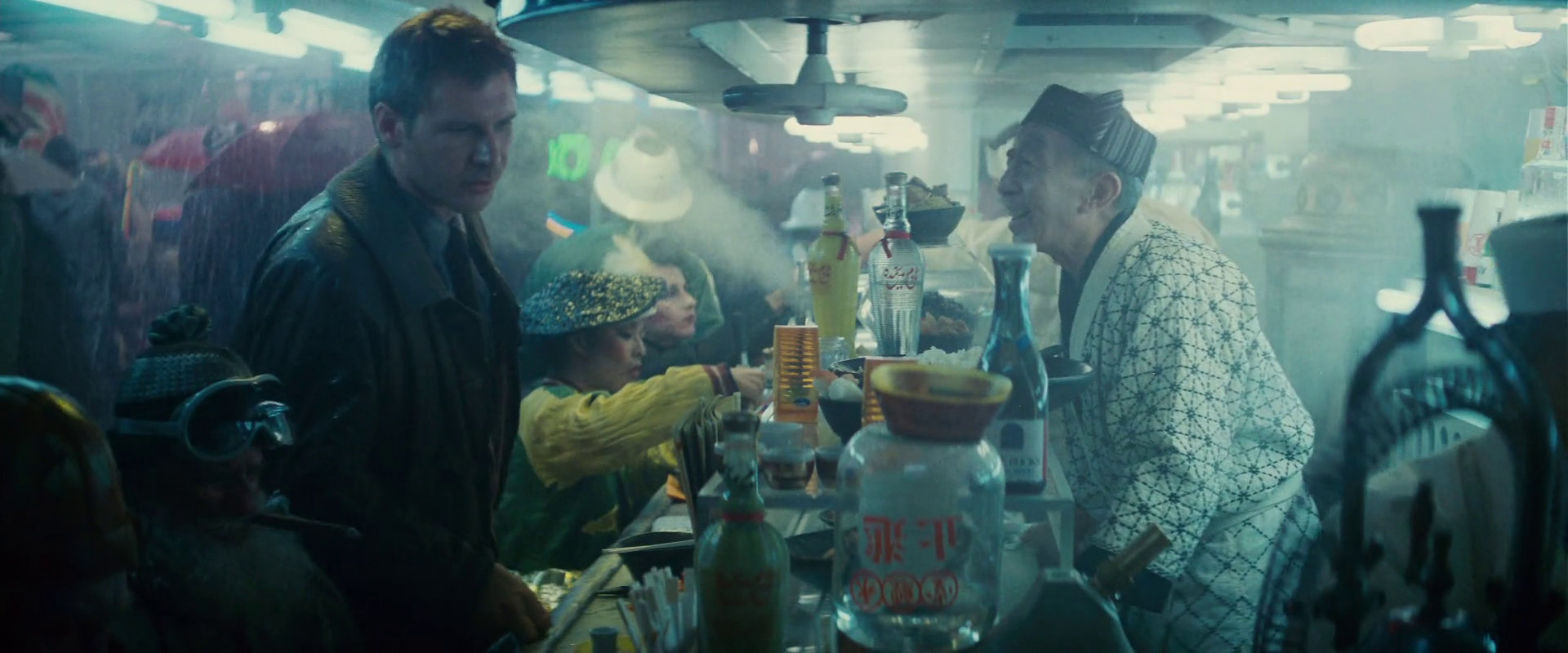
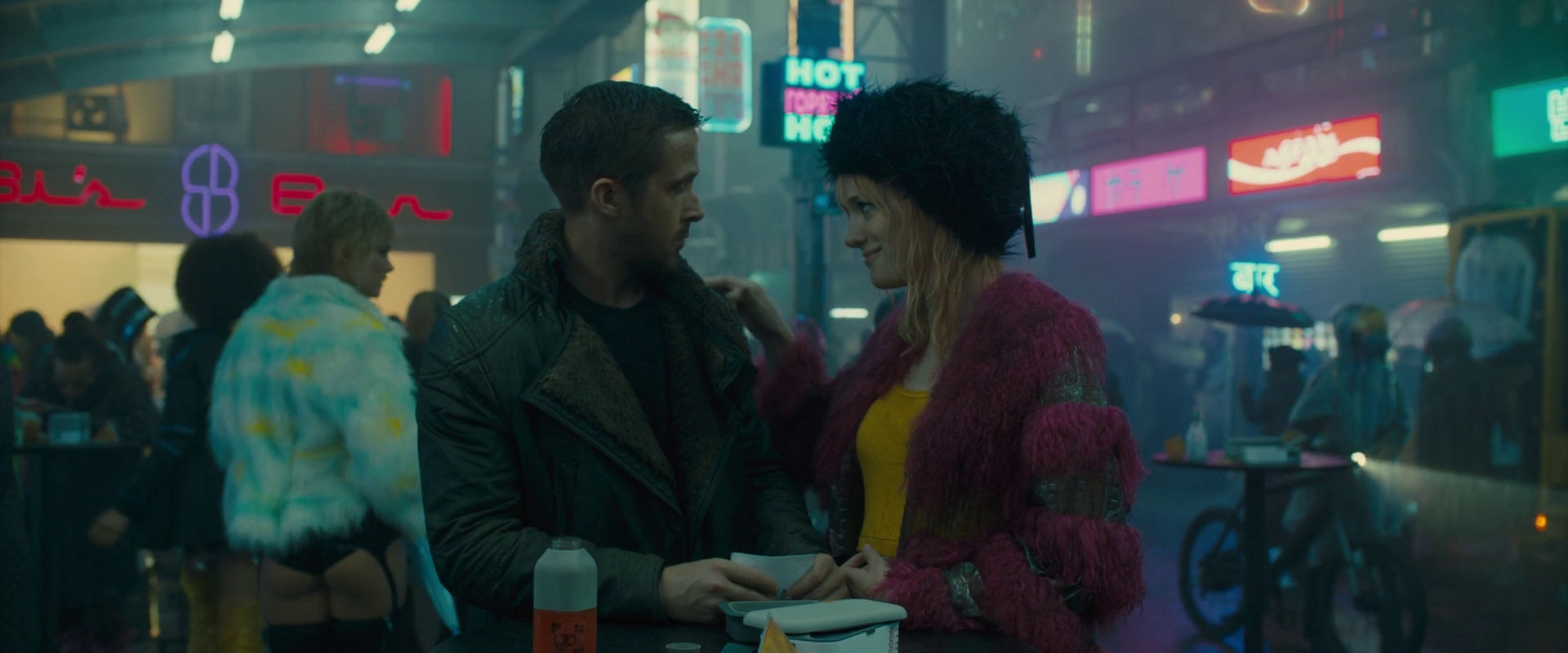
However, aside from the sharpness and details advantage, despite the technical limitations of colour negative film, there is an artificial “smearing” of the image quality present in the digital video here that is not attractive, and while it attempts to simulate the colour grading of the original film in that similar scene, it is clearly a digital substitute made to replicate (poorly) tungsten light balanced film. In addition, the out of focus areas in the original Blade Runner shot on film are rendered in an immersive, textured film grain, while the noiseless digital blur in Blade Runner 2049 that looks like it could almost be computer-generated as a background.
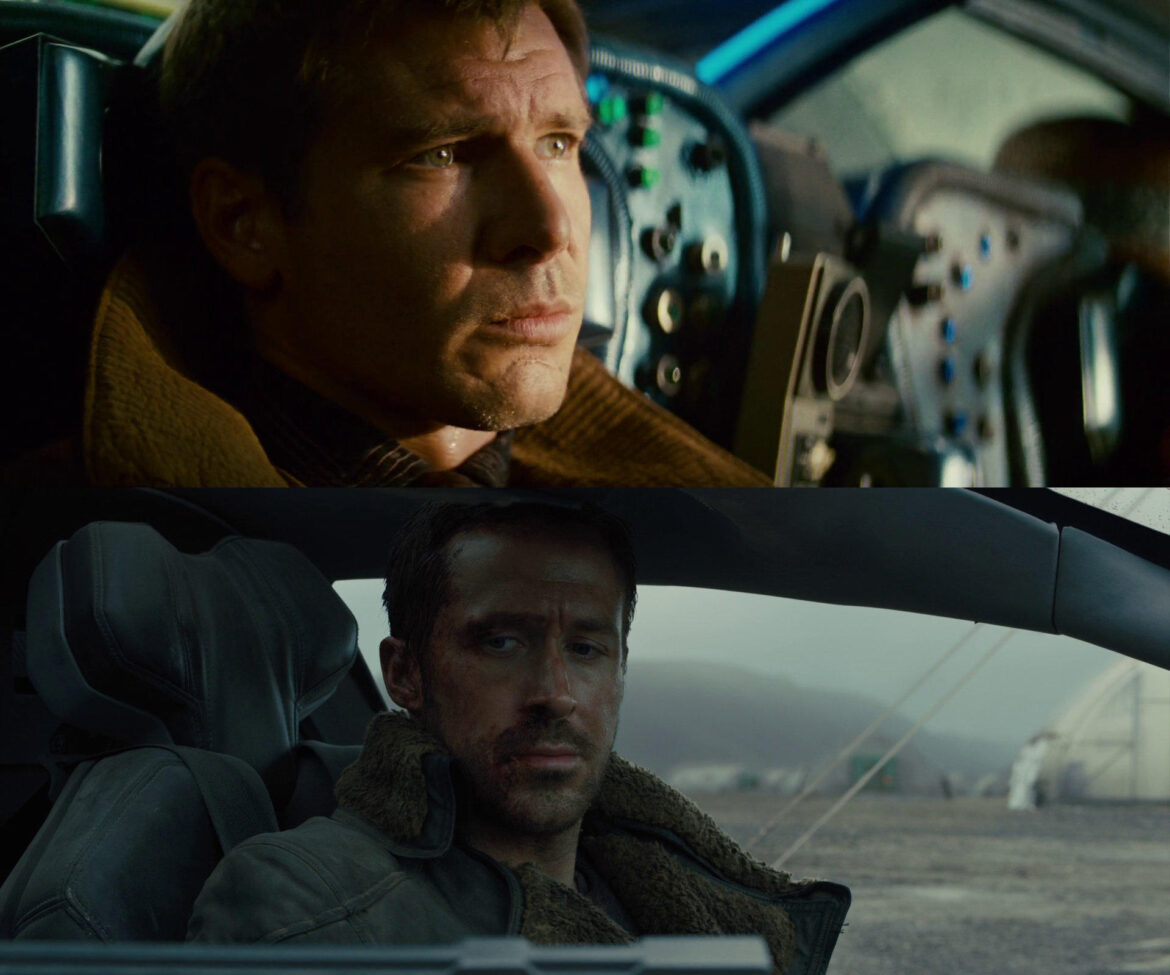
Once lighting is more adequate, the superiority of digital in terms of sharpness and detail fades away, particularly for close up shots, as shown in Figures 3 and 4 below, where the colour negative film of the original has just as much detail and sharpness available to the shot, together with more pleasing colours and rendering to its digital successor. The advantage of digital here is being able to shoot in shadows, as Gosling is not directly lit as Ford is, but has significant detail and sharpness in the dark areas. Thus, an advantage of digital is flexibility to get image quality even in shadow and not depend on advanced lighting techniques. However, I would argue, subjectively that, a creatively lit scene shot on film as in Figure 3 is superior in aesthetic to an unlit shot where the subject lies in shadow shot on digital as Figure 4. The high contrast noir effect of the original provided by film is lost in the subdued, but detailed shadows in Blade Runner 2049‘s digital capture.

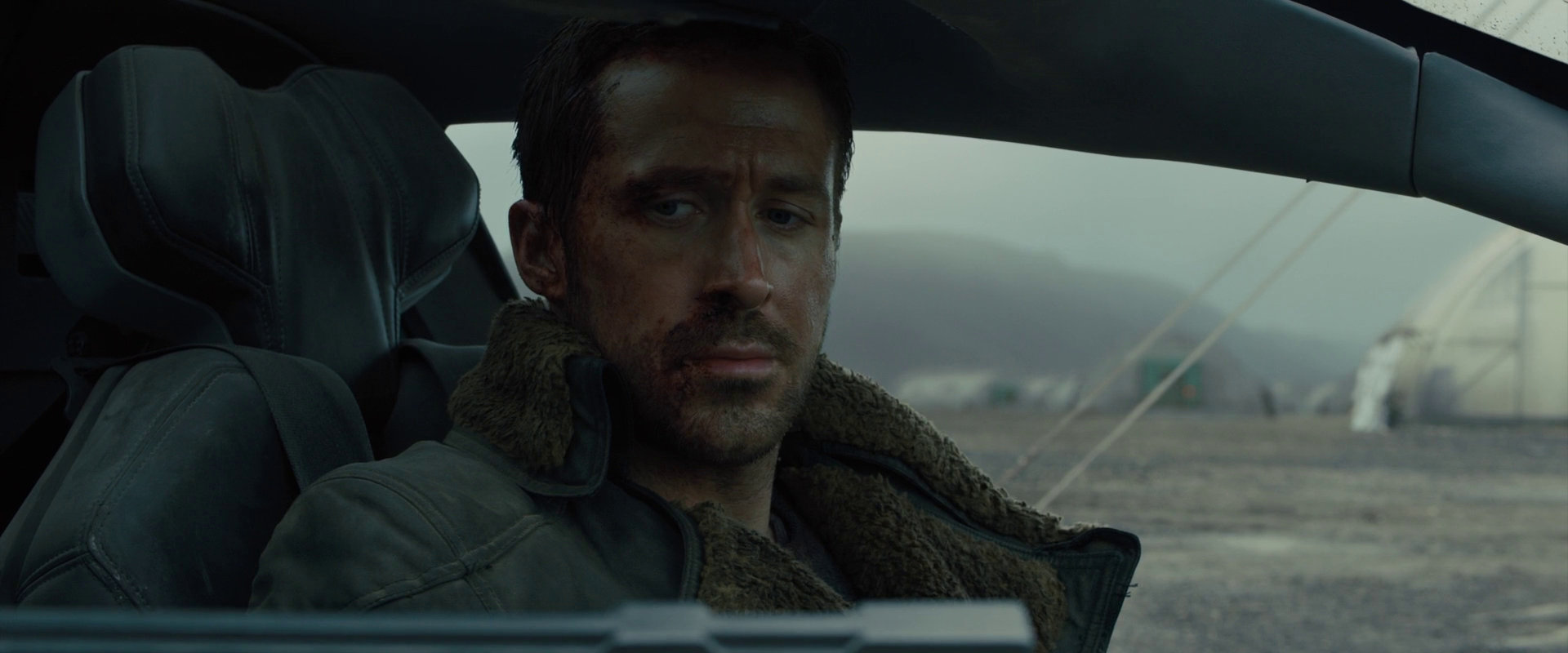
Before moving to the next technology shift analysis, I would like to point out how derivative many of the shots taken by Villeneuve are from the original. Finding near 1:1 recreations of the 1982 film’s scenes in the 2017 movie was not at all difficult. These “recreations” could be argued to be an “homage” but from my perspective, with Blade Runner 2049 being a sequel within the science fiction genre using these allegedly superior production technologies, they comes off as more creatively bereft than expertly crafted tributes.
Technology Shift 2: From Practical Effects to CGI
The second major technological shift in movie-making that has occurred between 1982 and 2017 is the development of more advanced CGI, which has largely taken over practical effects in most, but not all, films today. Ridley Scott utilised significant practical effects with a future Los Angeles being recreated for some scenes with entire scale model sets that were then shot on colour negative film. Villeneuve on the other hand rendered these scenes for his movie almost completely on a server farm. Practical effects studio WETA was contracted to do 38 scale models of the buildings in Blade Runner 2049‘s LA, however, the extent of CGI that was overlaid on these few structures was not significant enough to counter the film’s overall artificially rendered aesthetic and WETA’s involvement feels frankly as performative as Vangelis’ credited involvement.
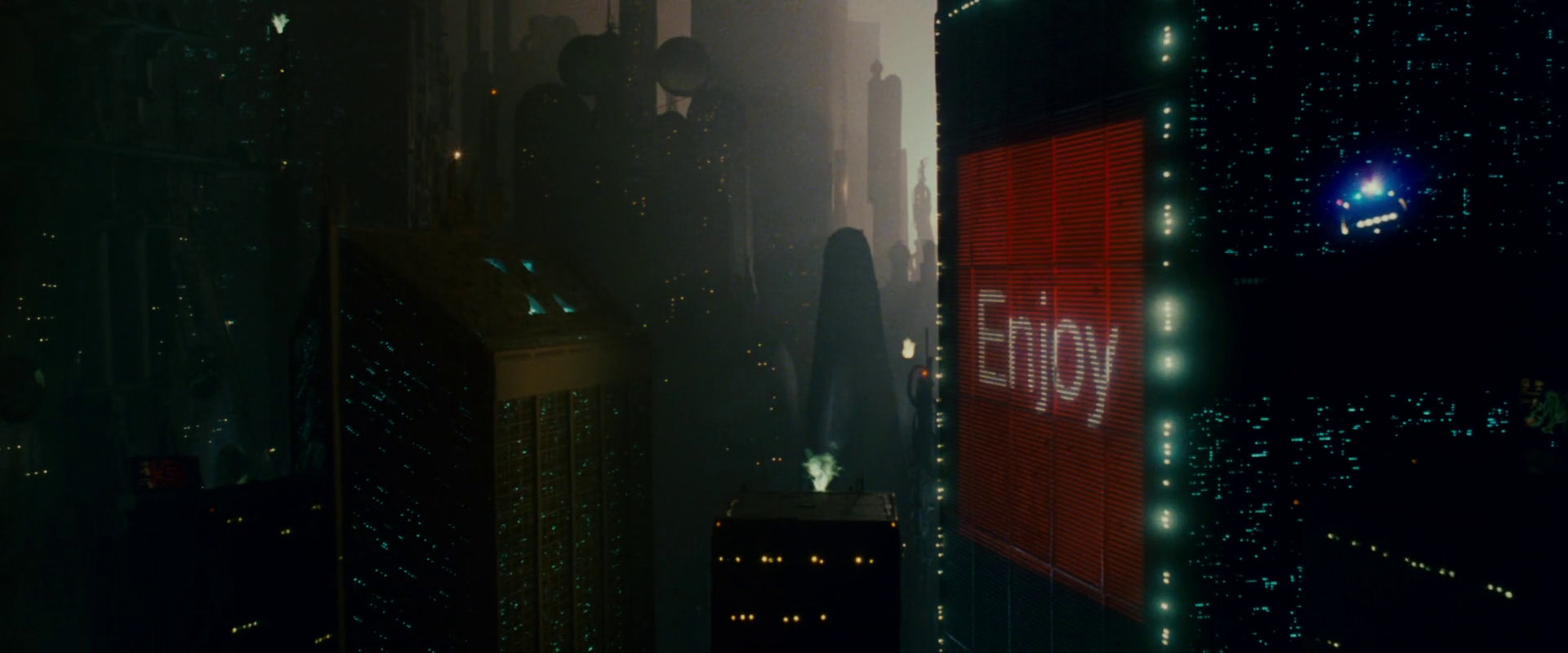
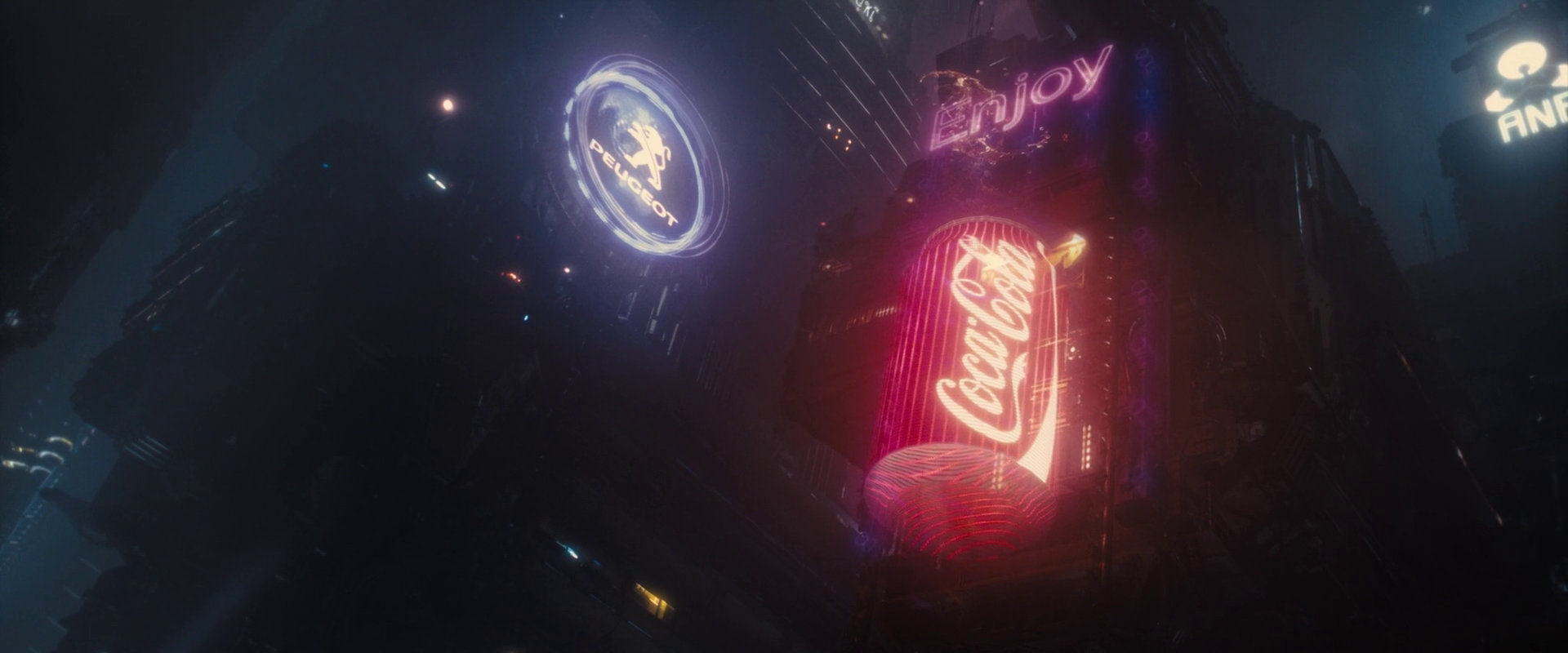
More than twenty years after the original film’s release, Blade Runner 2049 still cannot compete with the practical effects that immersed audiences in 1982 in the the futuristic Los Angeles of Blade Runner. This is despite Villeneuve’s production having a budget many factors over Scott’s original film. This is shown explicitly in Figures 5 and 6, where both movies attempt to depict the same futuristic Coca-Cola ad. The 2017 film’s rendering looks akin to the level of CGI one would expect to see on an inexpensive television commercial or even in a video game. In contrast, the practical effects in Blade Runner provide a more immersive, and also expansive, city scape using this older production technology.
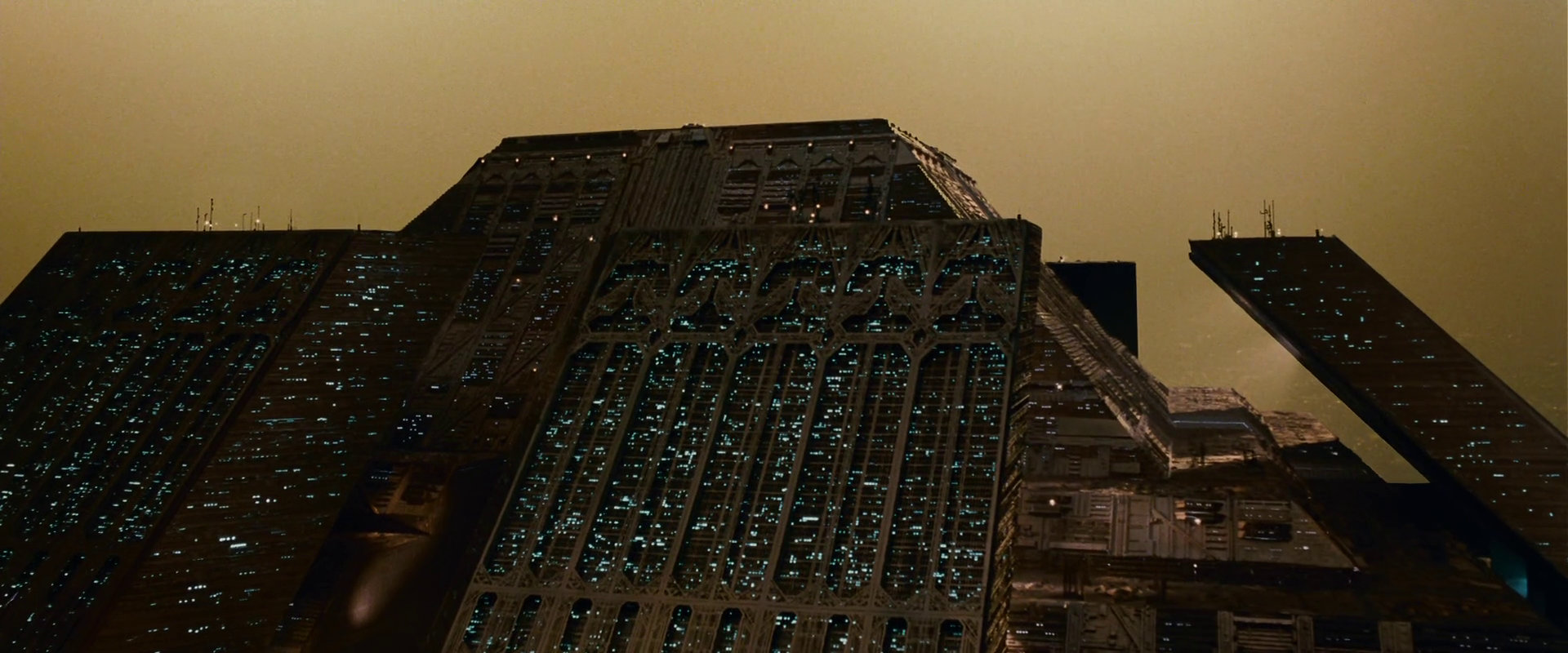
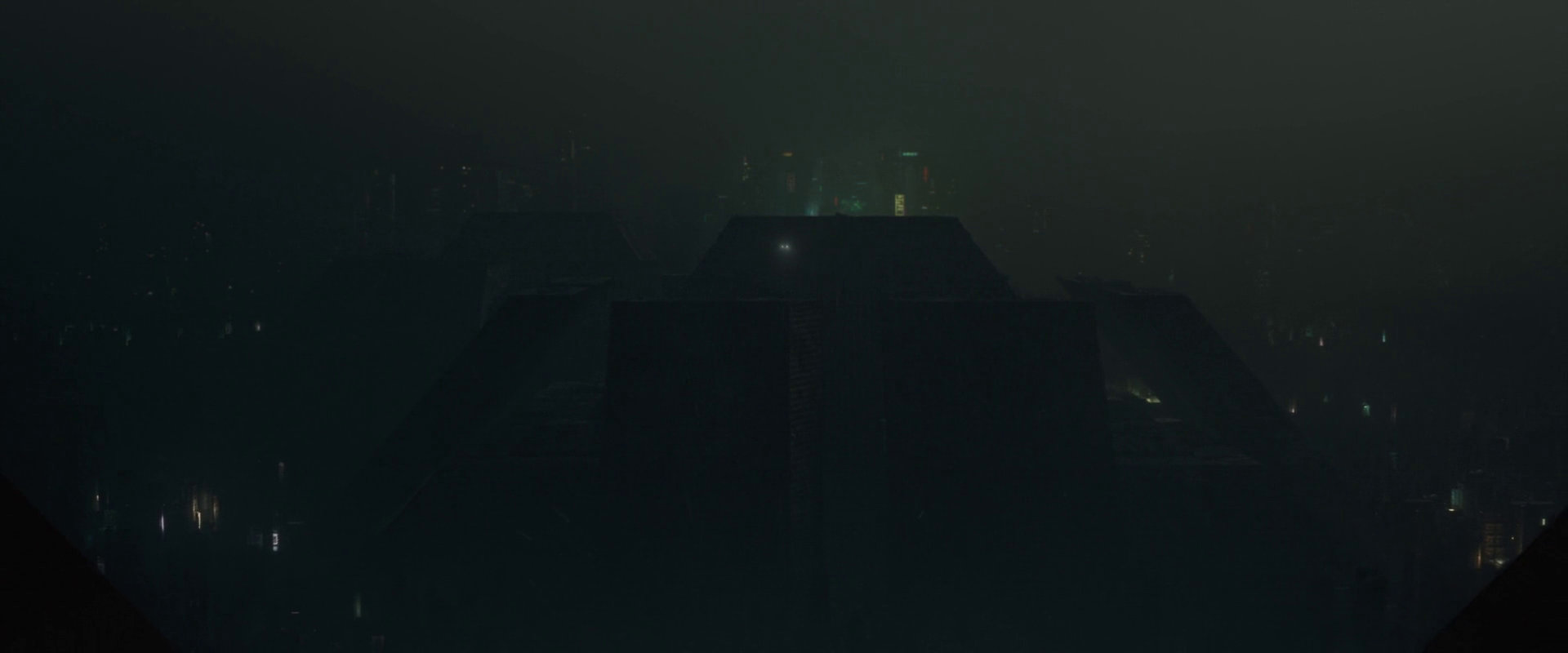
Another point where CGI is inferior, which can be seen in almost all of the computer rendered scenes in Blade Runner 2049, is that Villeneuve has to rely on filters that provide atmospheric haze or are simply extremely dark to disguise how fake and unrealistic these scenes look, especially in comparison to Scott’s practical models. In figures 7 and 8, the same “Tyrell” building is shown, looking photo-realistic as a model in the 1982 film, while barely even visible in Villeneuve’s 2017 sequel.
CGI might allow film makers to outsource many aspects of imaginative effects to dedicated rendering farms, but the results are clearly inferior under direct comparison. Perhaps CGI might look more realistic than an animated cartoon, but it is clear that even in 1982 there were practical effects available that were far more realistic and thus immersive for audiences. CGI’s benefits again lie in cost and time savings at the expense of the finished product.
Technology Shift 3: From Physical Sets and Mise en scène to “Green Screen” Digital Composites
Interrelated to CGI, but with much more significant impacts on a film as a media/text, is the evolution of chromakey technology that has allowed for digital composite scenes to be shot as an alternative to built sets, props and other authentic physical components of a film’s mise-en-scene. While Scott’s film did have certain built practical effects scale model sets that no actors interacted in, and Blade Runner did use a more rudimentary form of chromakey, for example to show the interior cockpit of the film’s flying cars laid over those model sets; these alternatives to built sets were used considerably less than they were in Blade Runner 2049, or pretty much any other science fiction or fantasy movie made in the 21st century.
Rather than building large sets and populating them with props, and human extras all adorned in costumes with weather effects and lighting actually provided to give the actors a sense of being in the futuristic setting they had roles in, as was the case in Blade Runner, instead, in Blade Runner 2049, actors like Ryan Gosling had to perform in sterile sound stages using chromakey with the sets filled out later with CGI renders. The result that Scott achieved is an almost tactile, vibrant atmosphere and realism. In Villeneuve’s sequel, this was replaced with CGI or, like in his Dune films, with sterile and muted sets.
This degradation in mise-en-scene is clearly illustrated in Figure 9 which depicts Tyrell’s office in Blade Runner versus the extremely inauthentic looking CGI background in Figure 10 of the Wallace building interior in Blade Runner 2049. It should be noted that such is Villeneuve’s derivative-ness that even the warm colours and repetitive pillars in these scenes are replicated from the original’s scene; thus allowing for such apt comparison.
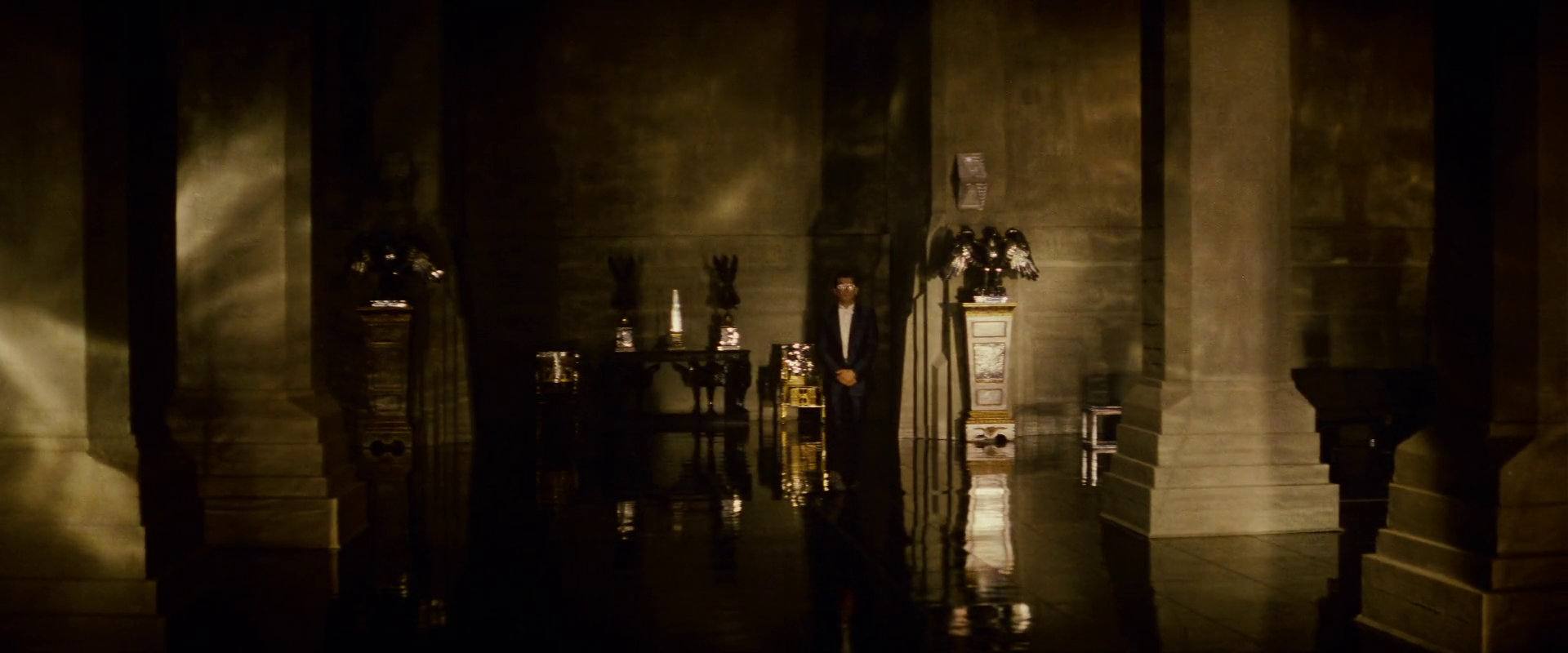

CGI’s promise as a technology to allow film makers to create anything in their imaginations, especially in the science fiction genre where the only limits should be the imaginations of their directors, feels incredibly disappointing for audiences when the production team responsible for films like Blade Runner 2049 just copy scenes and imagery from earlier works. This is especially frustrating when foundational works like Blade Runner created truly unique and inspiring imagery for their narratives using technologies that were more hands-on, challenging and time-consuming like colour negative film, practical effects and built sets; and all done with less resources than contemporary films with their bloated budgets.
The reason why this happened is obvious from a commercial perspective. There are considerably less reshoots needed when videoing actors in a sound stage and the costs of producing large sets, especially ones that need to appear outside, is avoided. With chromakey and a sound stage there is no need for leaving large practical sets up and standing for reshoots if they are needed, they can be done at any time, and the sets and other parts of the mise-en-scene are built in post production and changed as needed as well.
The way sets and props and mise-en-scene are treated with CGI and chromakey technology in Blade Runner 2049 is equivalent to how sound post-production was handled in Blade Runner and other earlier movies: as something that could be inserted in and edited later. And while on the topic of music, Villeneuve’s film completely disappoints yet again, simply referencing the original work by Vangelis as blatantly and superficially as the imagery was copied, and not coming anywhere near that original iconic work in quality. 35 years on, technology that one would assume has neutrally “evolved” has simply gotten more efficient at quickly outputting inexpensive substitutes to actual art.
While not something that could be directly considered technology, it should also be noted that even the costumes were extremely unimpressive in Villeneuve’s sequel. Harrison Ford’s iconic “cyberpunk” look was reduced to a t-shirt and a pair of jeans. Jared Leto simply wore a kimono. Together with the sterile, artificial looking sets, chromakey’d in actors, a relative lack of interesting props, the uninspired and forgettable costumes of Blade Runner 2049 create a completely banal and unimaginative visual work relative to the stunning original film.
Independently, these technological changes could be argued to have limited if any detrimental impacts on the quality of a film. However, it is argued that when combined, the effect they have on overall production and the creation of a film is significantly negative; and this is not a problem only observable in Blade Runner 2049 but almost all science fiction and fantasy movies in the last twenty years. If those sterile muted sets are apparent to audiences of the theatrical release of Blade Runner 2049 as shown in Figure 10, imagine how much more sterile and empty it would have been for Gosling and other actors trying to create compelling performances in sound stage that resembles a near empty box.
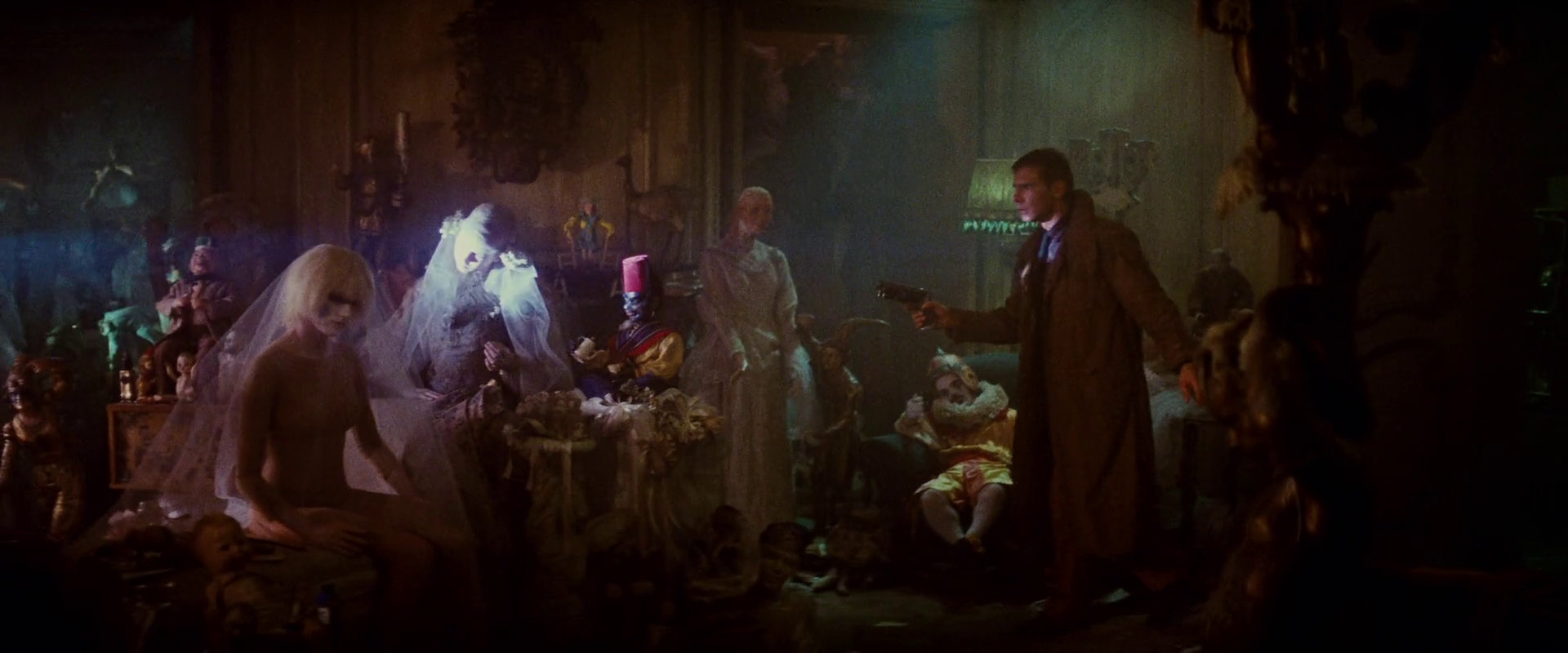

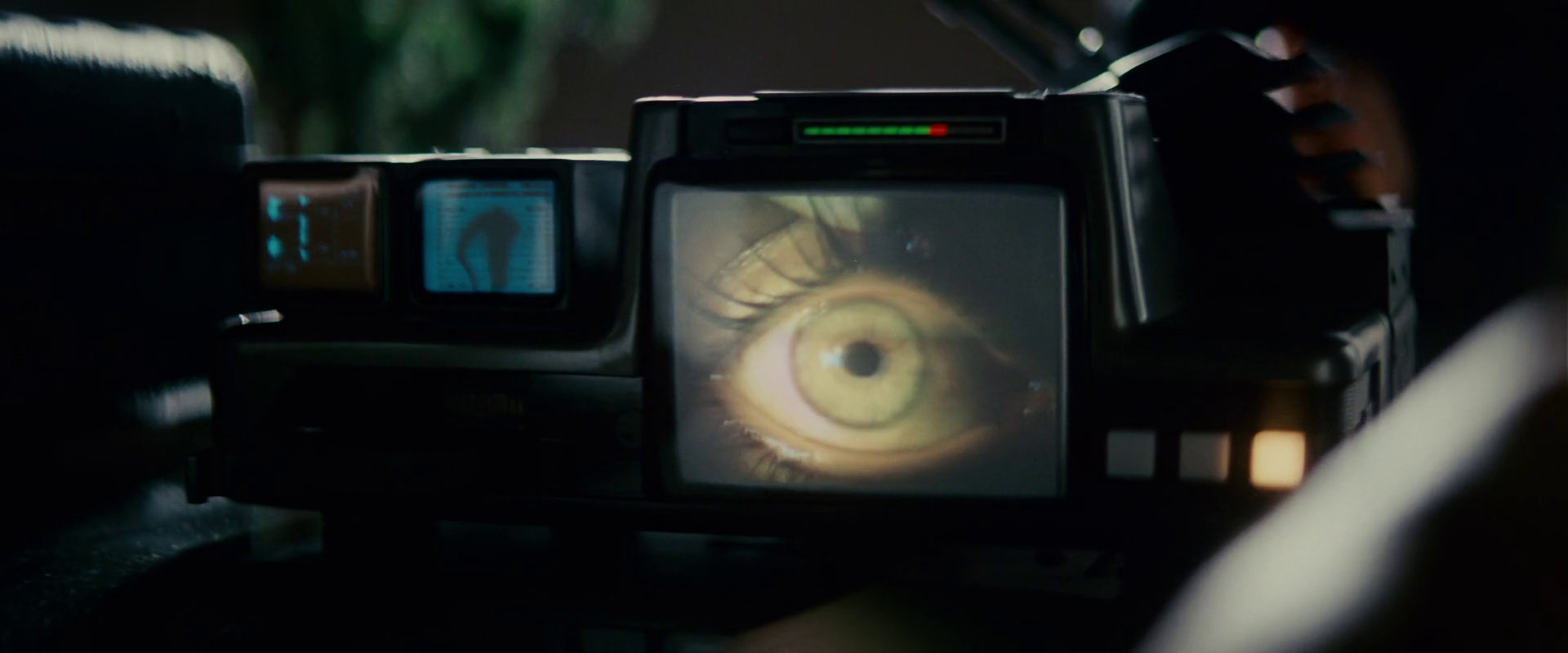
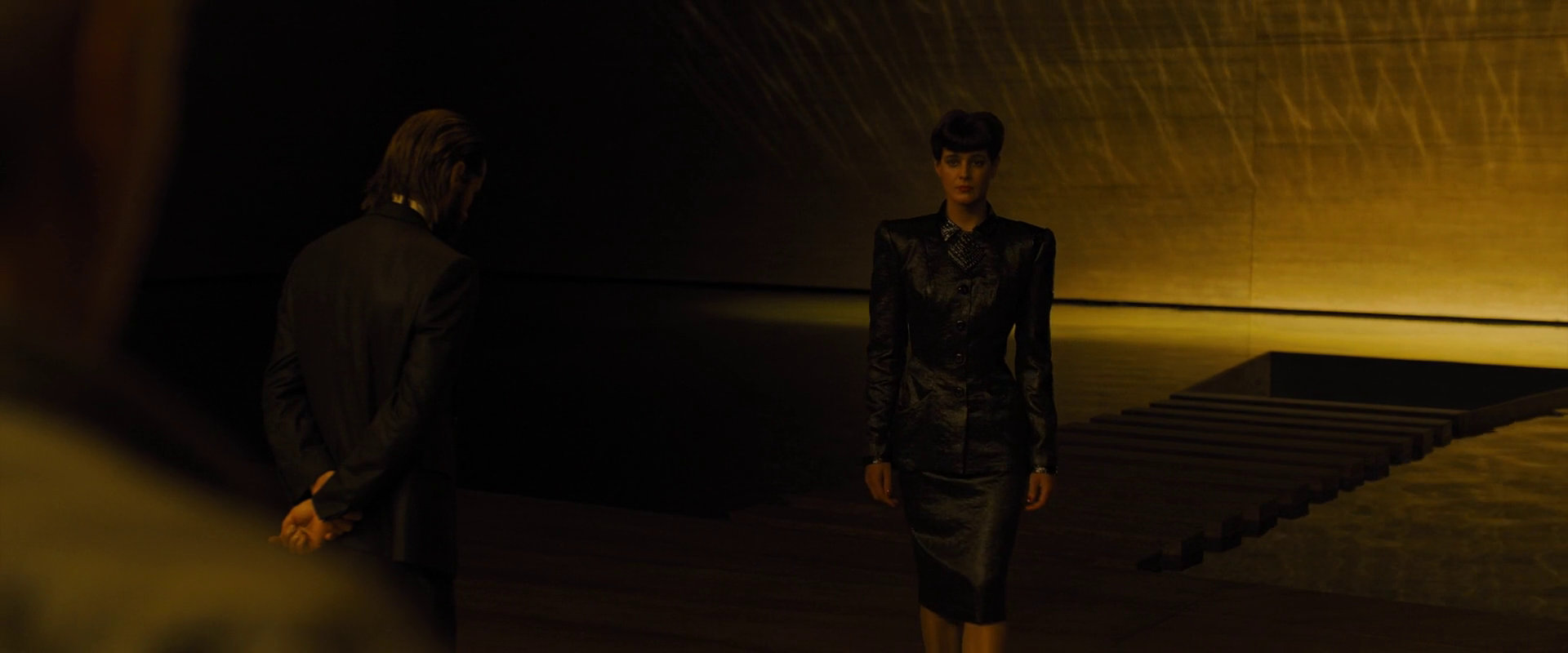
In Blade Runner, Harrison Ford was wearing a eye-catching, custom-made trench coat, (Figure 11), acting in large completely physically built and lit sets, as seen in Figures 1 and 9, alongside his fellow actors, often interacting with props like the Voight-Kampff machine ( Figure 13) to deliver a truly inspiring performance for the narrative. In Blade Runner 2049, Ford is wearing a t-shirt and jeans (Figure 12) with almost no props, and has to play a role with a chromakey’d in CGI version of the actress who played Rachel (Figure 14). Danesi mentions Blade Runner’s Voight-Kampff machine over twenty times in their 2024-written article on AI-generated popular culture, as a testament to how enduring and iconic such a prop was to the film for audiences, 2 let alone for the actors and other roles in the production tasked with giving “life” to the film. There is not a single prop or element of new visually imagined technology in Blade Runner 2049 even close to this. The film itself is a “replicant” of the original, similar in look and sound, only but lacking in humanity or originality, which are two traits that are sorely needed in the medium, but are denied because of excessive use of these modern technologies like digital video, CGI and chromakey. Is there any wonder that the performances of all the actors in Blade Runner 2049 are uninspired, and the entire film itself is derivative and lacking anything truly impressive, as a science fiction film of this budget and calibre should be? The audiences do deserve better, as do the actors and other professionals involved in such modern productions.
Conclusion
It has been illustrated that all three technological innovations that took place in the 35 years between Blade Runner and Blade Runner 2049 have been at a detriment to not just the aesthetic quality of the sequel film, but its entire value as a narrative. This not a problem unique to Blade Runner 2049 and in fact most big budget science fiction and fantasy films now suffer similar problems. Ridley Scott and his team were able to create one of the greatest science fiction films of all time using older “inferior” technology like colour negative film, practical effects, scale models and large sets with a physical mise-en-scene. Denis Villeneuve created a hollow, superficial and derivative copy with a narrative that has nothing new to say or to show audiences. These new movie-making technologies have have been developed out of convenience and cost effectiveness, rather than for the sake of art and human expression, and in doing so, it has brought down the quality of films as texts, their abilities to create inspiring narratives and in fact has been a detriment to the medium of film itself. Thus, the development of technology in this case, used for creating media, has only evolved in order to create lower-quality, less humanistic outputs to increase profit off audiences. Being able to recognise this is an important component of our media literacy.
Typically with these kinds of critical, if not sobering, pieces, we as readers are left with the sentiment that: “well, things are bad, but what can we do?”. Mark Fisher’s Capital Realism comes to mind, where his only solution to the problem was hope that an omnipotent AI may come to power to save us from the forces of capitalistic oppression.
I am not going to end this article with such a fatalistic statement. I will tell you, that you as a consumer do have a choice. Your dollars do matter. Your support is important. Do not support media that is produced with such commercialised technologies. Support independent media, music, fashion, art, games, and books. Reject conglomerate-produced branded white noise. You not only limit the amount of poor quality, shallow media that you consume in your wonderful mind, but you also financially punish those that cynically produce junk that we certainly do not need more of. Give your dollars to those that are making the world better. They are out there. At the very least, you’ll look like you have taste.
Fair Use Statement: This article contains images hosted without express permission from their copyright holders. These images are provided for illustration purposes to support an informational objective. This should constitute fair use of any such copyrighted material.
References
- Nolan, C. (2012). ‘The Traditionalist’. (J. Ressner, Interviewer)
- Danesi, M. (2024). AI-Generated Popular Culture: A Semiotic Perspective.