By: XEONIQ [ Instagram | Tumblr ]
Contents
- Introduction
- Otomo’s Television Commercials for the Canon T70
- Otomo’s Print Media for the Canon T-70
- The Canon T70: A Brief Review
Introduction
Katsuhiro Otomo is one of Japan’s most famous manga illustrators and film directors who was influential in introducing more realistic science fiction narratives into Japanese animated media. He is best known for Akira, which was a highly popular manga serial that he started in 1982, and then went on to direct its feature length anime adaption [ LINK to SHELLZINE Cyberpunk Anime List ].

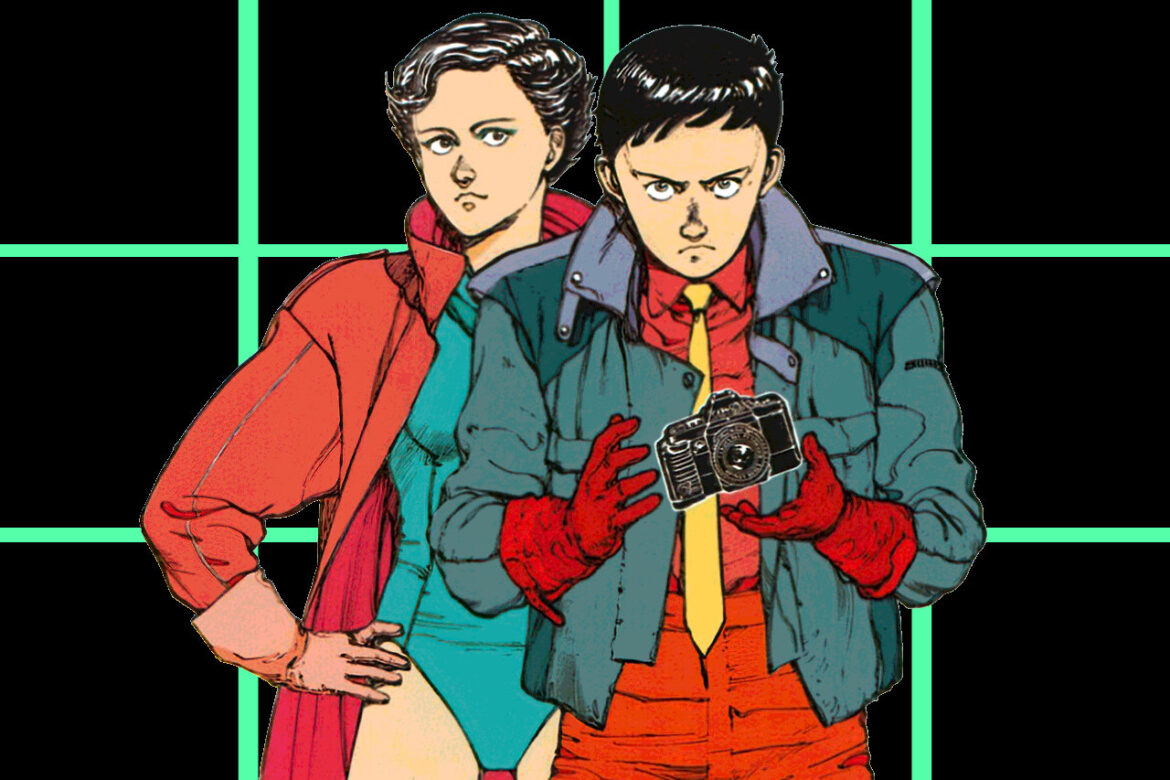
But before the Akira film came out in 1988, Otomo was commissioned by Japanese camera company, Canon, to create animated television commercials for the Japanese and global markets, as well as a slew of illustrated print media and merchandise. The project was to help promote Canon’s new T70 electronically controlled Single Lens Reflex (SLR) 35mm film camera released in April 1984, ahead of the Olympic Games where Canon was a major sponsor.
This collaboration between Canon and Otomo is significant for a number of reasons. The 1980’s was a very successful decade for Japan as a nation, where it rose to power with an economy that was set to overtake the United States as a world leader. Part of this rapid growth can be attributed to rapid progress in technology, with 35mm film coming to dominate as a preferred choice for consumers and professionals alike and companies such as Canon, Minolta and Nikon at the forefront of innovation in this market; with Canon being a global leader since the late 1970’s. At the 1984 Olympic Games, Canon was ready to show the world the latest state of the art micro-processor controlled camera system, and with Otomo’s pioneering work in bringing science fiction to manga, he was chosen to create a similar Akira-esque futuristic aesthetic narrative of for the Canon T70. Thus, the collaboration between Canon and Otomo was a presentation of the marriage of Canon’s technological innovation in devices that create media with Otomo’s emergent vision of the future AS media.
As the Canon T70 was my first 35mm SLR camera, and on account of the significant influence Otomo had on inspiring other manga artists and then anime directors for the science fiction, if not cyberpunk, genre, I decided to pay homage Otomo’s promotional work for Canon and also provide a brief review of the T70 camera.
I searched for hosted copies of the Japanese and English versions of the television ads and print media, however the quality overall was quite poor. I decided to perform minor digital enhancements using Audacity for the TV sound and Affinity Photo to remove noise, sharpen and reduce defects in the print media and video frames.
Particularly for technology products which promise to enhance human activities as tools, the commercial funding and the context specific requirements of creating advertisements that align with a corporation’s brand and the product being promoted, provides the opportunity for creating elevated, culturally-relevant art that is perhaps not possible for many artists, who can lack funding and who can be rather insulated, for better or worse, from mainstream culture. This makes specific high quality examples of commercially-produced artwork unique and worth preserving and appreciating.
With more and more companies simply relying on low effort and/or AI-generated content for their promotions, projects of this calibre may become rarer and rarer over time. Following the TV commercials and print media I have restored, a short review of the T70 for those who enjoy shooting 35mm film will conclude the article.
Otomo’s Television Commercials for the Canon T70
I sourced the two Japanese language and one English language television commercials that Otomo produced for Canon’s T70. I then ripped every frame, upscaling and reducing defects. I also cleaned the audio tracks in Audacity and embedded them with the cleaned video before encoding.
This video includes:
- Canon T-70 Future City Episode: English Version
- Canon T-70 ハイウェイスター篇 (Highway Star Episode): Japanese Version
- Canon T-70 未来都市篇 (Future City Episode): Japanese Version
The song used in FUTURE CITY is Takumi Iwasaki’s Fragments of Time (1984). Part of this track has a similar motif to Geinoh Yamashirogumi’s Kaneda, one of the most well-known anime scores ever made for the 1988 feature film adaptation of Akira. It is interesting to see this early musical reference that originated in the selection for one of these Canon TV commercials.
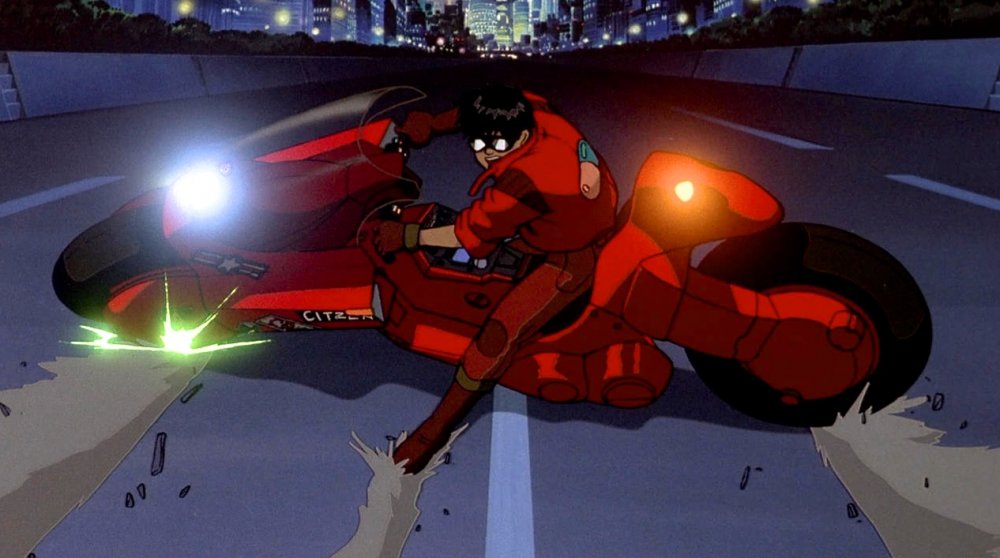
One interesting aesthetic feature in all these works is the prominent use of the colour red, which is mirrored in Akira. Red is one of the dominant colours of Imperial Japan, the red sun, with Otomo being heavily influenced by the atomic bombing at Hiroshima and Nagasaki, as many of his generation were. The “dawn of the new era” slogan again references the sun, supporting this connection. Even Canon’s premium line of “L” series lenses are red-ringed, which can be seen in several of the frames in the advertisements. Japan’s ambition to recover from its losses, in economic, cultural and technological competition rather than military, is well observed in these symbols within the superficial futurist aesthetic and themes.
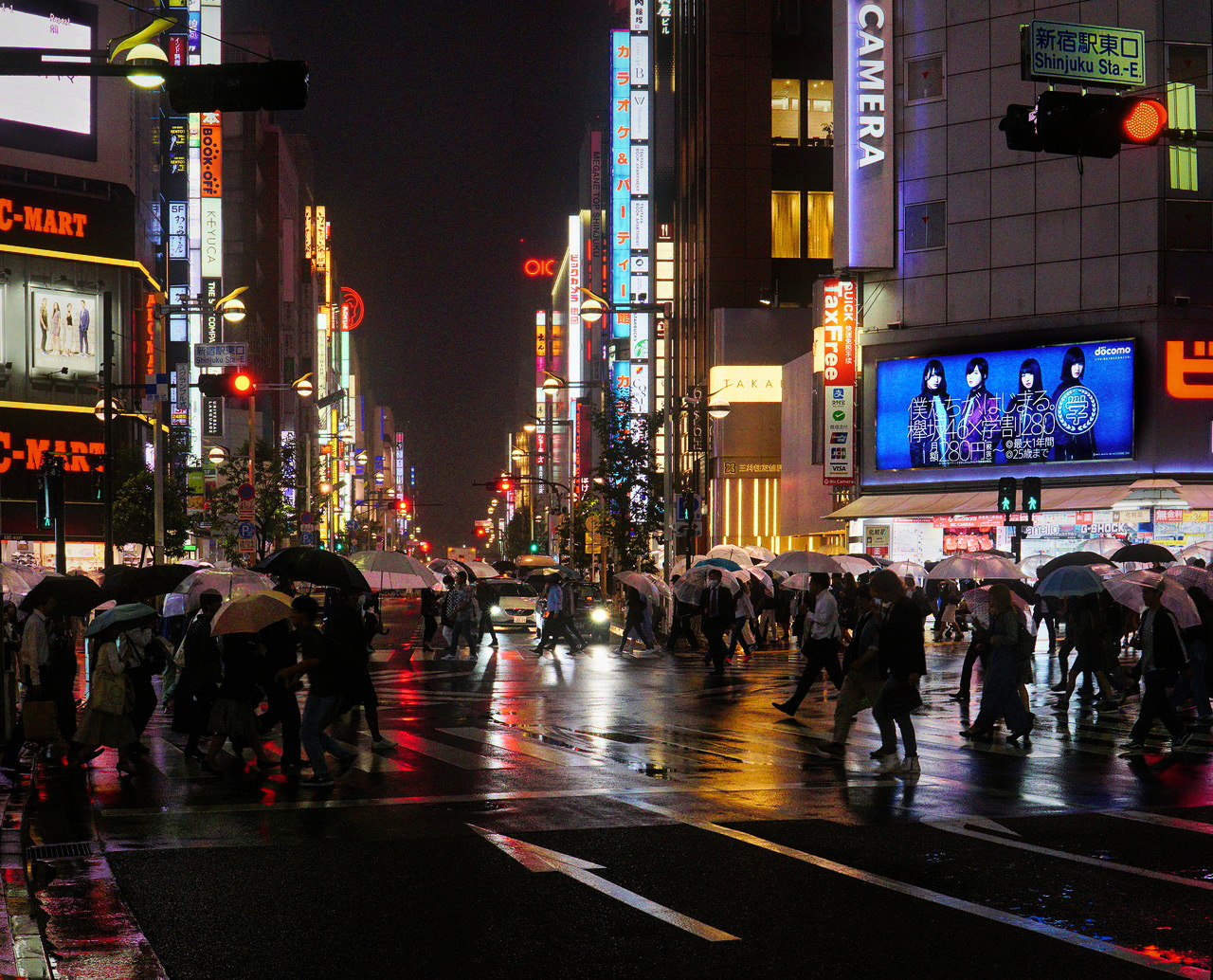
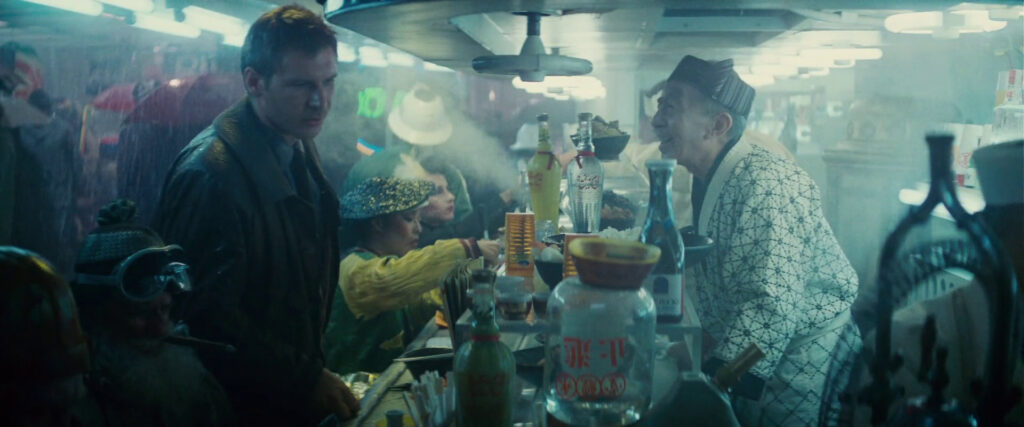
A key defining part of Cyberpunk as a Western sub-genre of science fiction is how it grappled with the then impending take over by the surging Japanese economy of the 1970s and 80s. The palatable fear of Eastern replacement is embedded in media from Blade Runner to Neuromancer with Japanese cultural artefacts if not characters or organisations represented repeatedly in all of the genre’s iconic media. What is interesting here, is that the intersection between futurist Japanese media and Japanese consumer technology marketing is clearly also communicating a similar transformation in East/West power dynamics, however from the opposing side.
The entire suite of promotional video and print materials communicates the rising Japanese power in technology and media that defined the 1980’s and unequivocally influenced cyberpunk as a genre .
Otomo’s Print Media for the Canon T-70
Searching online, I was able to find a number of posters and even some promotional merchandise that was produced for the Japanese market to promote the T70, including a brand new pack of playing cards, and a set of sealed sticker decals being sold on Yahoo! Japan auctions. Like the video, I have found poor quality scans or photographs of the items on image servers and even listings of items for sale and then digitally enhanced them using Affinity Photo for archive purposes.
Posters
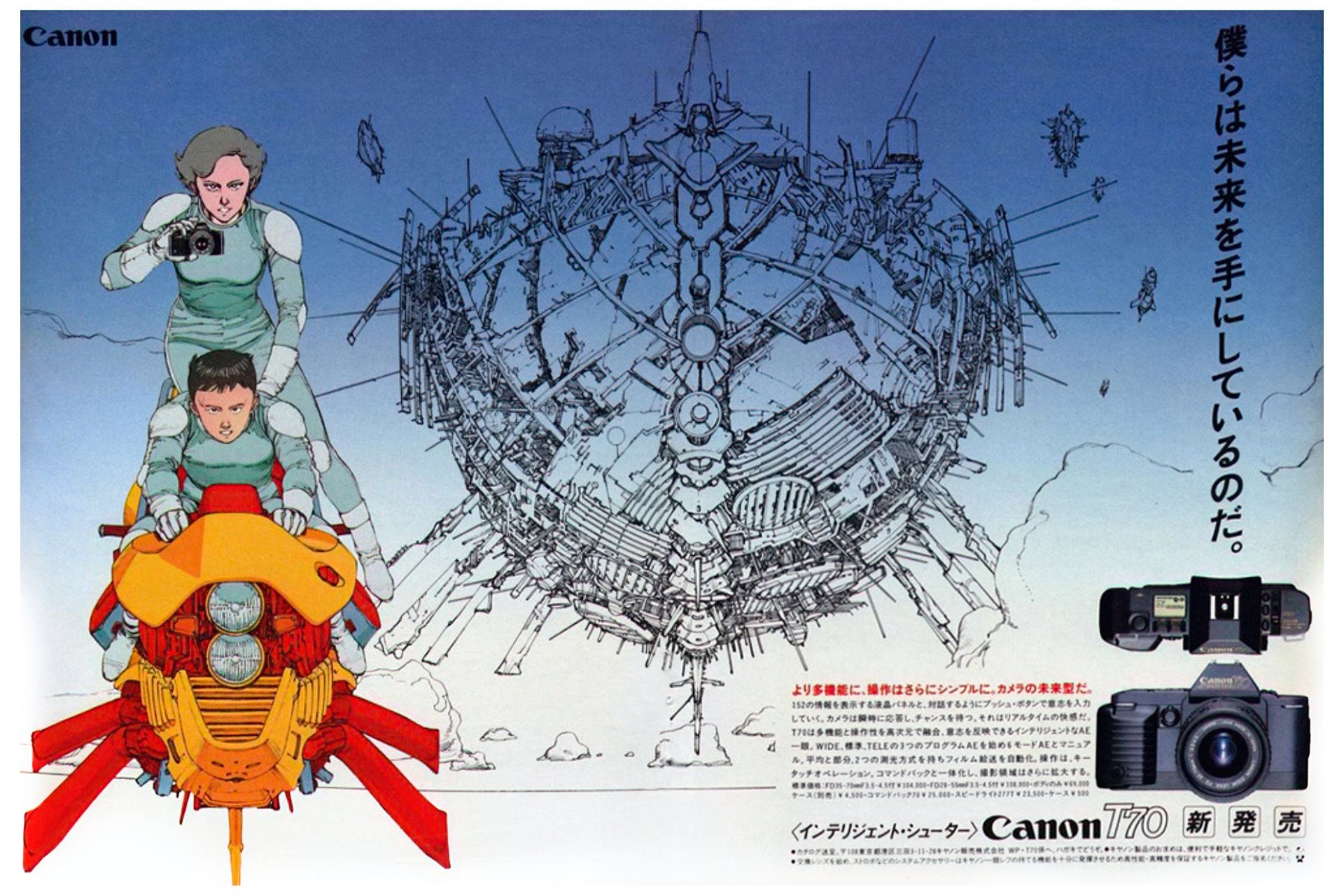
This Canon T70 promotional poster reads: “We have the future in our hands”.
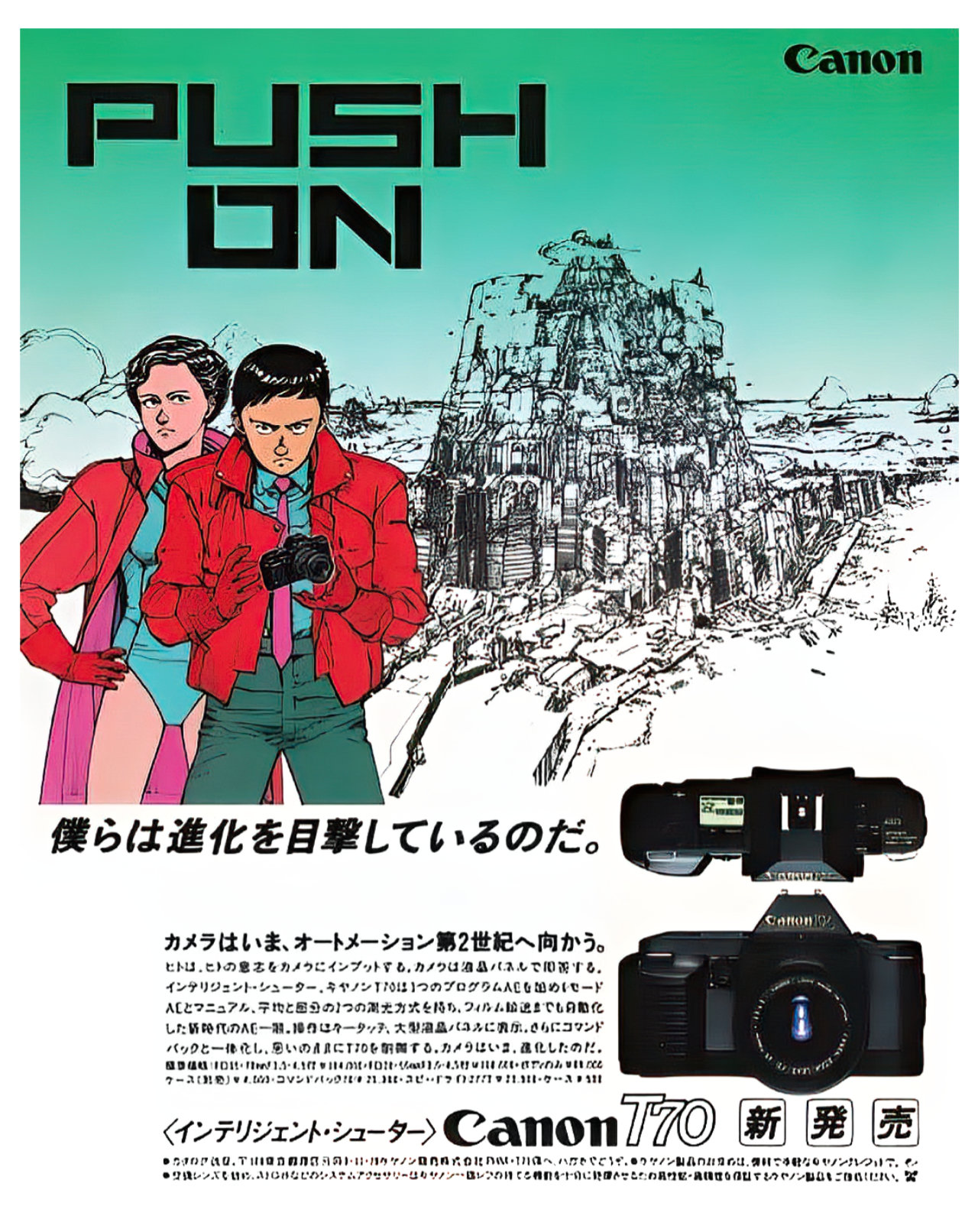
Prominent headings on this poster read: “We are witnessing evolution.” and “Cameras are now heading into the second generation of automation.”
Merchandise
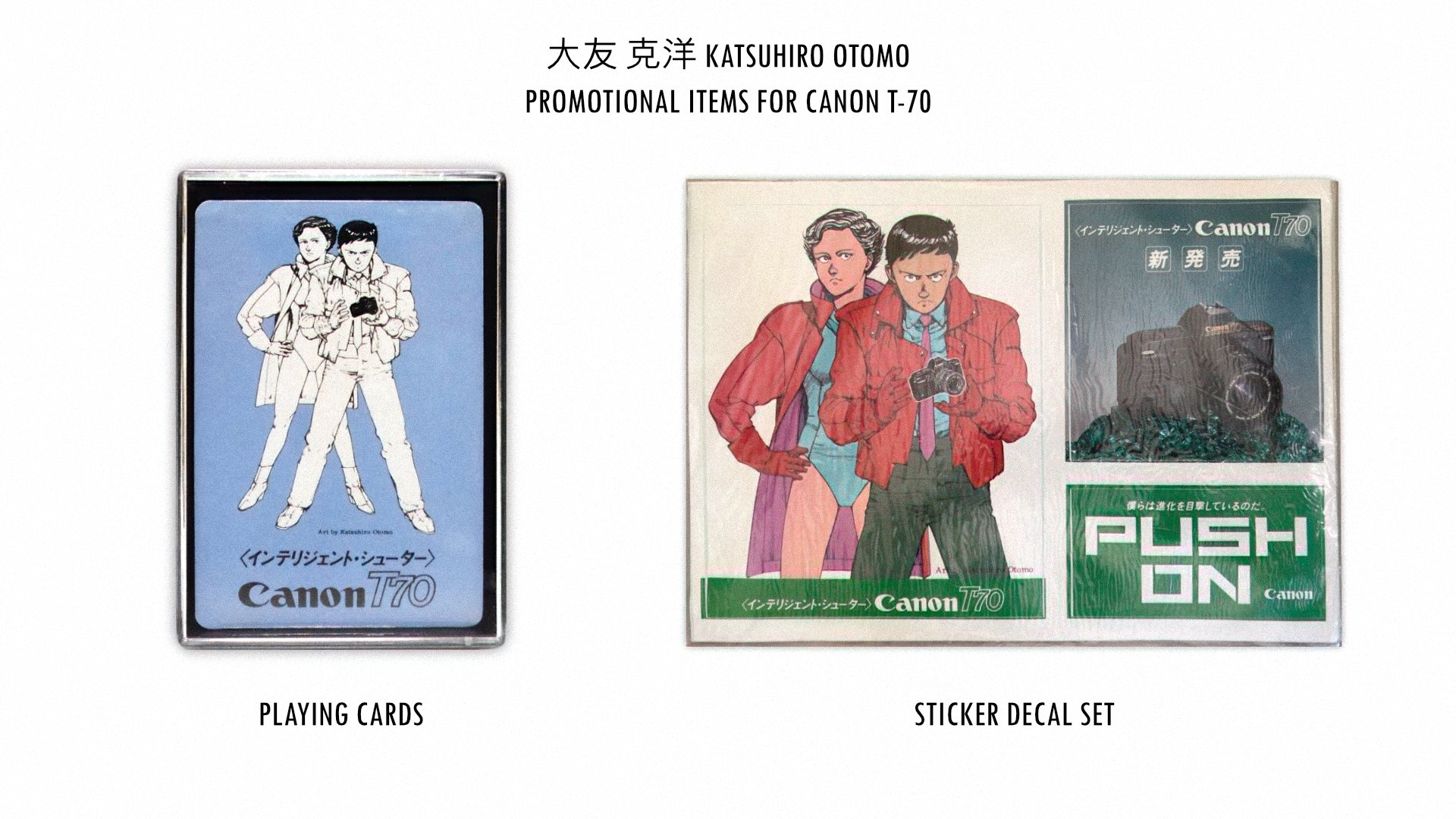
These items were found on Y!JP auctions. The left is a set of 52 playing cards and the cover reads: “Intelligent Shooter”, which is shared on the sticker set to its right with the T70’s PUSH ON slogan.
Illustrations
The two illustrations below were found in higher resolution than the other media in this article and are most likely scans from one of Otomo’s art books. I was thus able to significantly enhance the scans.
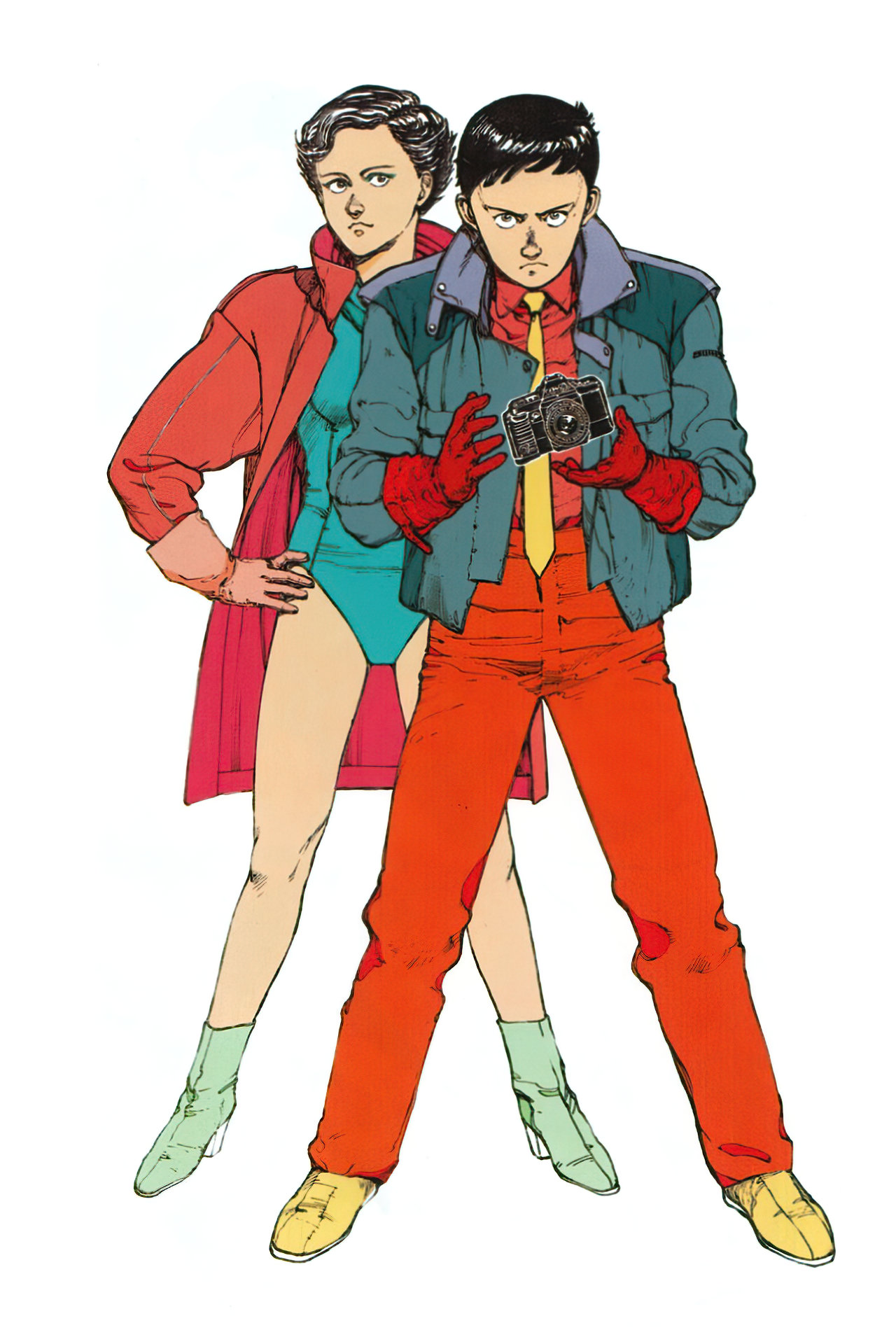

The prominent use of red can be noted in all these colourised artworks, even where the characters are not specifically adorned in red garments, their hover bike is.
If you enjoy Otomo’s drawings, the latter two illustrations are sourced from the art book: KABA: Otomo Katsuhiro Artwork 1971-1989. KABA includes a number of sketches and illustrations of these characters specifically, and of many others Otomo created during this early pre-90’s period.
The Canon T70: A Brief Review
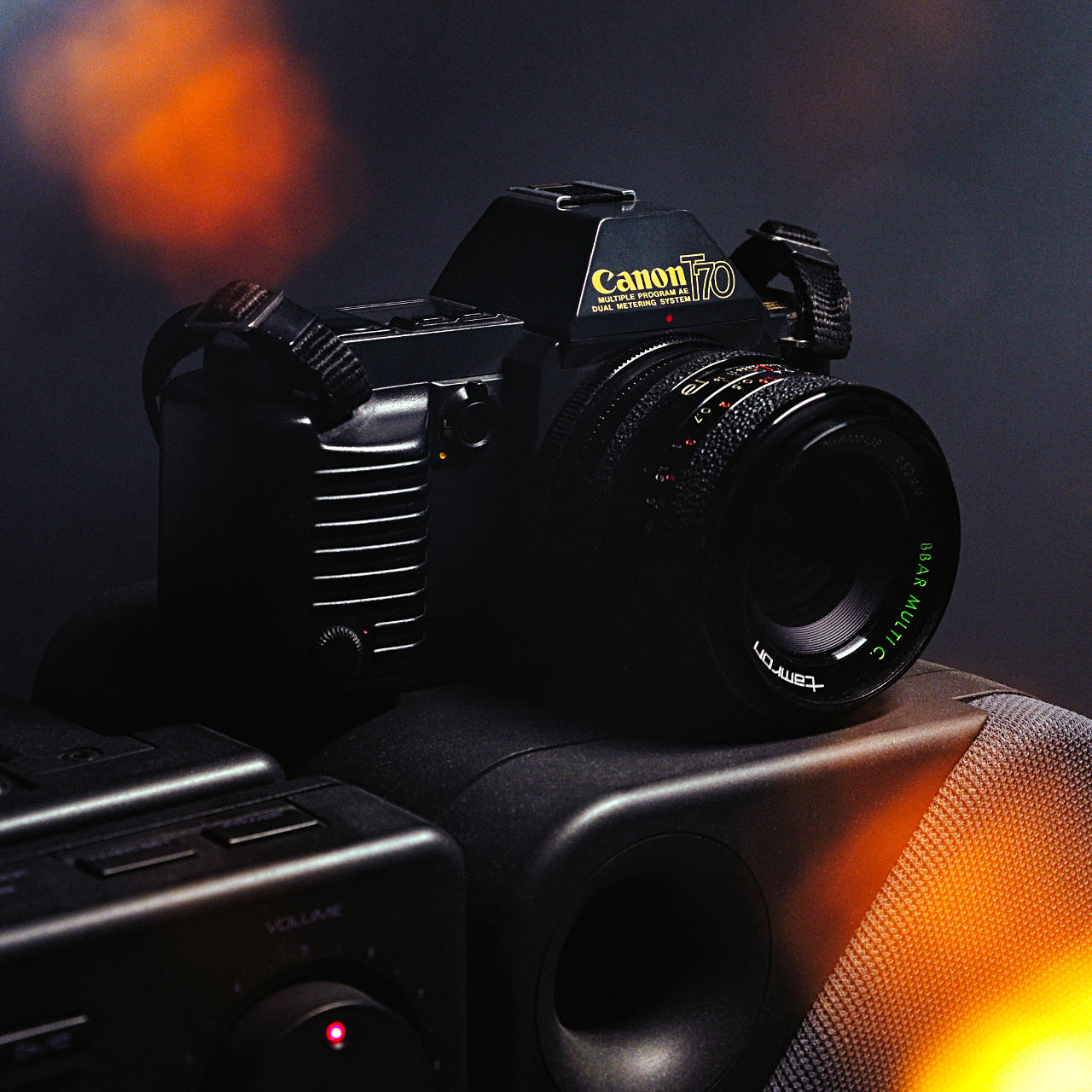
SPECS
- Mount: Canon FD manual focus lenses
- Max Shutter Speed: 1/1000 sec.
- ISO Film Range: 12 to 1600
- Automatic Film Loading and Advance
- Power Rewind
- Fixed eye-level pentaprism with 0.85x magnification and 92% coverage
- Laser Matte with microprism/new split combination rangefinder
- Battery Type: AA
Canon T70 PDF Instruction Manual: External Link
1984 Launch retail price in Japan: ¥69,000
Having owned the Canon T70 for many years alongside a number of Canon and Minolta 35mm SLR cameras, I will offer the following impressions of the T70 as a tool.
The Canon T70 is relatively small for a film SLR, and it’s light weight with its plastic design compared to earlier Canon generations that featured more metal in the bodies.
The T70 doesn’t get light leaks because of its back design, which is a large benefit as many 35mm film cameras, now 30+ years old, have rotting light leak seals and if you are new to film cameras, replacing them can be frustrating.
While the T70 does not have an aperture priority mode, which many people prefer for automatic exposure control, it has 3 unique program modes that work quite well in practice.
- TELE mode prioritises opening the aperture as large as possible, providing a smaller depth of field and faster shutter speeds; which can be useful for portraits, low light photography, and action shots.
- WIDE mode opens the aperture as small as possible while retaining a useable shutter speed, and can be useful for a large depth of field for landscapes or close up photography.
- P mode is a safe balance in the middle that works as a general “auto” mode.
Shutter priority (TV) and full manual are also available on the T70 in addition to those 3 program modes.
Another practical benefit is that the T70 uses AA batteries, which is nice to be able to easily get replacements while travelling as many film cameras use specialty batteries, which can be hard to source if you haven’t brought extras with you while out shooting.
For a camera released in 1984, the level of over-engineering is very impressive for these devices to still be functioning.
Finally, these cameras can be purchased for as little as $USD10 on sites like eBay or Y!JP auctions and have not enjoyed the same appreciation in value that many pre-80s film cameras have. It is significantly more reliable and cheaper than many older options, which makes it a good beginner camera if you’d like to try 35mm film photography.
I would not recommend anyone buying this camera if you are already invested in another lens system or have other FD mount cameras in your collection. But if you are thinking of getting into 35mm film photography one day and do not yet have a camera, the T70 is a robust, affordable starting point. The FD series of manual focus lenses that the T70 uses are good quality and some of the best L series glass still hold their own even today. For a low cost starting lens, the FD 50mm f1.8 is cheap, sharp and one of the smallest lenses for the system.
Below are a few of my favourite shots that I took with my Canon T70 using Cyberpunk 35mm film, either 320-T or 640-T. You can read my review of that 35mm film product here: SHELLZINE LINK

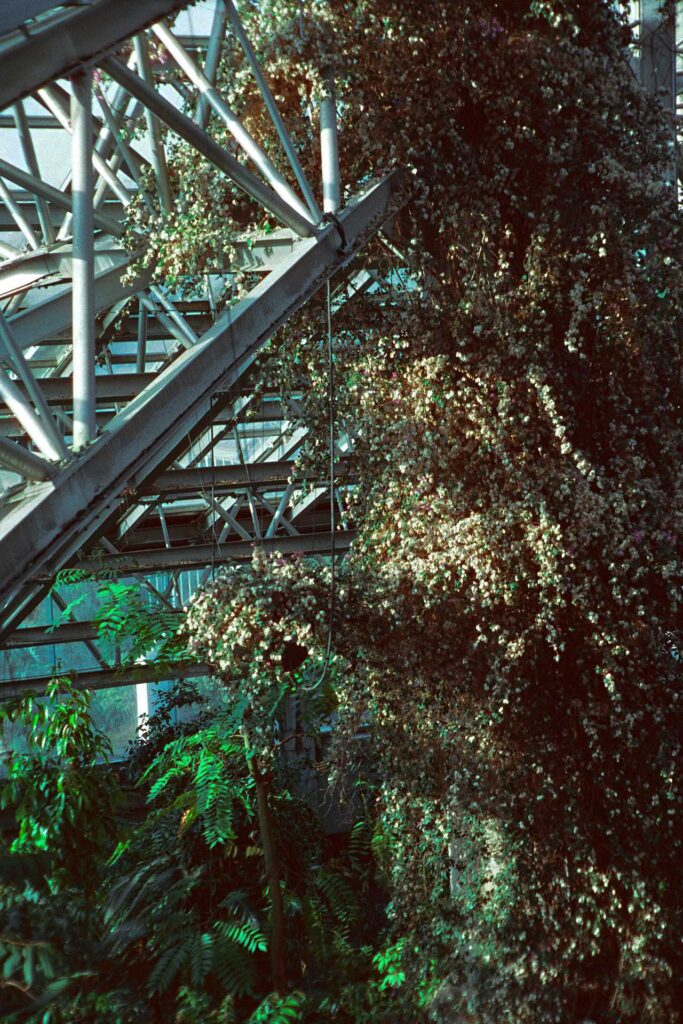




The shots below were taken with the T70 was shot on Fuji Natura 1600, an unfortunately long discontinued high ISO colour film.
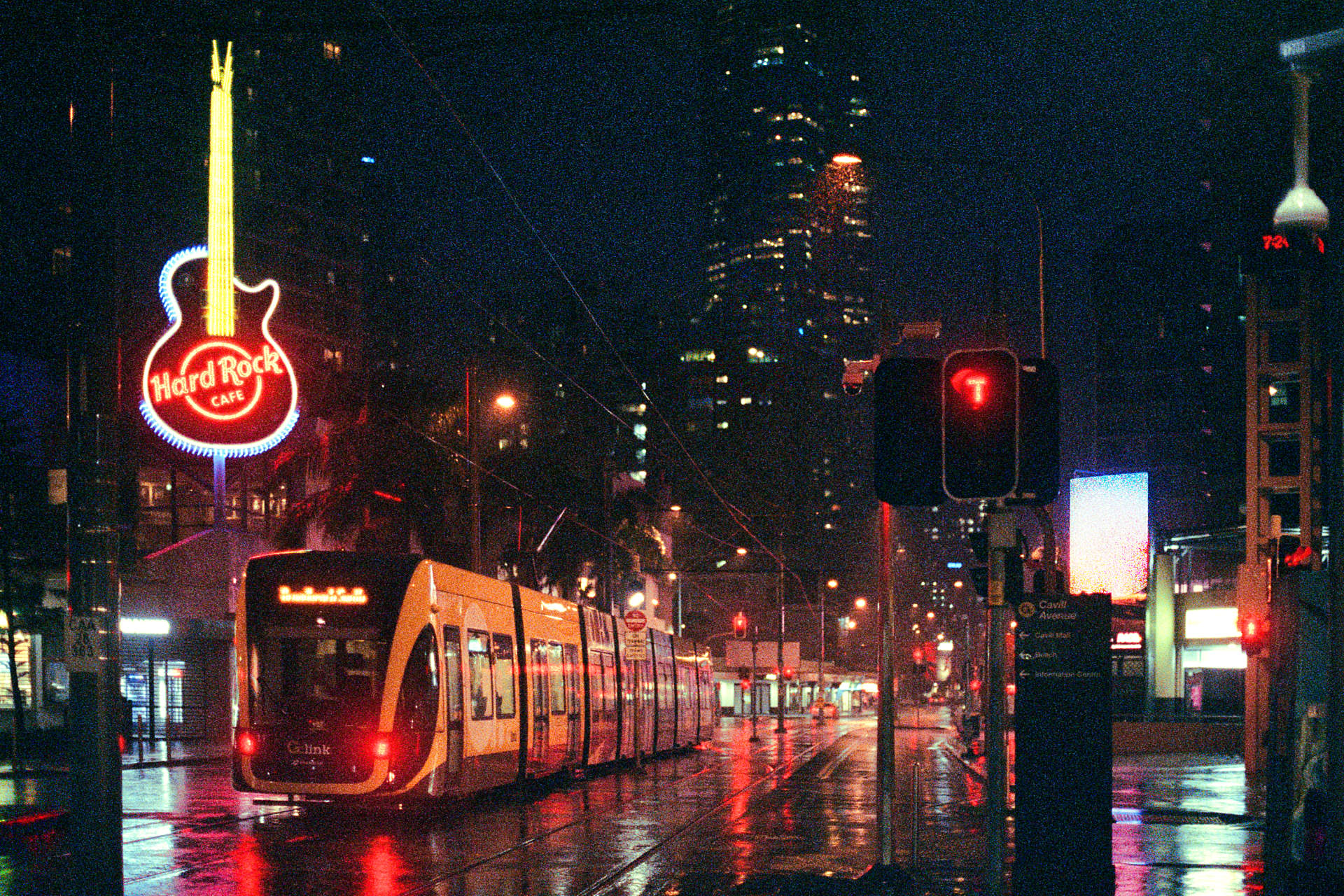

If you would like to see more of my cyberpunk-themed photography, you can visit my Tumblr or Instagram.
Fair Use Statement: This article contains images hosted without express permission from their copyright holders. These images are provided for illustration purposes to support an informational objective. This should constitute fair use of any such copyrighted material.